

Food dehydrators have quietly become one of the most useful counter appliances for home cooks, gardeners, and anyone trying to preserve a sudden surplus of produce. Whether you’re drying apple slices for lunchboxes, turning garden herbs into shelf-stable seasonings, or making jerky without additives, the right machine can replace hours of guesswork with consistent, repeatable results. The picks below cover a wide range of capacities and budgets, from compact five-tray starters to dual-chamber workhorses built for serious batch cooking.
A Quick View Of The Lineup

Magic Mill Premium Food Dehydrator Machine (10 Extra-Large Stainless Steel Trays)

Silicone Dehydrator Mesh Mats 11.4×11.4 8-pack

Magic Mill Pro Food Dehydrator 7 Full-Size Stainless Steel Trays 600W

Magic Mill Pro Food Dehydrator 10 Stainless Steel Trays

Magic Mill Premium DualZone Food Dehydrator 16 Stainless Steel Trays
Magic Mill Pro Food Dehydrator 7 XL Stainless Steel Trays
Magic Mill Food Dehydrator Machine 11 Stainless Steel Trays

Magic Mill Premium Food Dehydrator Machine (15 Extra-Large Stainless Steel Trays)
Magic Mill Food Dehydrator 5 Stackable Stainless Steel Trays
The Strengths Of Each Pick
This ten-tray Magic Mill hits a comfortable middle ground between capacity and counter footprint, which is why it ends up at the top of most shortlists. The 700-watt rear-mounted fan moves air across every rack, so you skip the chore of rotating trays mid-run, and the transparent door turns the whole thing into a window you can glance at while doing dishes.
The 95°-167°F range covers everything except the highest jerky settings, and the 48-hour digital timer lets you set it and walk away. For a family preserving apples, pears, and herbs every weekend, this is the kind of workhorse that disappears into the routine.
What Works In Its Favor
- Ten extra-large trays handle a full harvest batch without stacking overflow.
- Rear fan airflow means no manual tray rotation in mid-cycle.
- Transparent door turns monitoring into a passive glance instead of an opening.
- 48-hour timer supports overnight herb and fruit runs without babysitting.
- Stainless trays clean up faster than plastic and resist staining from tomato skins or berries.
Things To Consider
- The 167°F ceiling may feel short for cooks chasing ultra-low moisture jerky finishes.
- Owners commonly note the housing runs warm during extended sessions, so leave clearance around the vents.
Feature Snapshot
Who It Suits Best
Families and weekend preservers who want generous capacity without committing to a commercial-grade machine.
Consider Something Else When
Cooks chasing true dual-zone runs should look at the Magic Mill Premium DualZone Food Dehydrator 16 Stainless Steel Trays for its independent chambers.
These mesh mats are an accessory rather than a standalone dryer, but they solve one of the most common frustrations in the category: small, sticky foods falling through open-grid trays. Sized to fit the Excalibur DH08SCSS13 and other 11.4-inch-square dehydrators, the eight-pack gives you a dedicated surface for herbs, berries, and pureed fruit leather.
The non-stick silicone releases dried apple slices cleanly and rinses under warm water in seconds. Think of it as the missing layer between your dehydrator and a clean countertop.
Reasons It Performs
- Mesh design preserves airflow while catching small pieces like blueberries or herb leaves.
- Non-stick silicone simplifies cleanup and reduces food waste from stuck-on residue.
- Eight mats in one pack covers a full dehydrator load with spares.
Worth Noting
- Trays must match the 11.4-inch footprint, so confirm your machine before ordering.
- Thicker purees or pastes may dry slower on mesh than on solid liners, depending on humidity in your kitchen.
Right Fit For
Anyone drying herbs, small fruit, or fruit leather on a compatible mesh-style dehydrator who wants less food loss.
Look Elsewhere When
If you primarily slice large fruit or run thick jerky strips, the open-grid trays on the Magic Mill Premium Food Dehydrator Machine (10 Extra-Large Stainless Steel Trays) work fine without extras.
Where most home dehydrators mix stainless trays with plastic walls, this Magic Mill Pro goes fully metal, inside and out. That single choice changes how the machine feels in daily use, especially if you’ve been fighting warped plastic trays over the years. The 95°-176°F window stretches into true low-temp jerky territory, and the auto shutoff pairs with the 48-hour timer for genuinely unattended runs.
The seven full-size trays offer less square footage than the ten-tray sibling above, but the all-stainless build tends to justify the trade for cooks who prioritize longevity.
Noteworthy Benefits
- All-stainless interior, exterior, and trays resist heat stress and staining.
- 176°F ceiling reaches higher-temp jerky finishes that 165°F units cannot.
- Auto shutoff on the timer reduces worry about late-night over-runs.
- Rear-mounted fan maintains even drying across all seven trays.
Trade Offs
- Heavier than plastic-bodied models, so plan a permanent spot on the counter.
- Smaller tray count may bottleneck large single-batch apple or tomato harvests.
Key Specs
Made For
Home cooks who want a long-lasting stainless build and don’t mind fewer trays in exchange for higher temperature control.
A Better Fit Elsewhere
Garden-heavy households running big weekly batches will find more breathing room in the Magic Mill Pro Food Dehydrator 10 Stainless Steel Trays.
This Pro-tier unit shares the same rear-fan logic as the Premium 10-tray model above, but it lands at a step closer to an entry-level Pro experience. Ten stainless trays provide ample space for sliced apples, mushrooms, or homemade dog treats, and the digital timer takes the edge off long cycles.
You give up a few degrees of maximum temperature compared with the all-stainless Pro, but for anyone focused on fruit, herbs, and standard jerky, that ceiling rarely matters.
What Makes Sense
- Ten trays comfortably handle family-sized weekend batches.
- Rear fan airflow removes the need to rotate trays mid-cycle.
- Transparent door turns monitoring into a quick glance instead of an open-close chore.
- Stainless trays clean easily and resist absorbing odors between runs.
Room For Improvement
- Top temperature may feel limiting for low-moisture jerky preferences.
- Counter footprint is substantial, so plan a dedicated spot.
Quick Facts
Best Suited To
Mid-size households drying multiple foods per session and wanting predictable, even results.
Swap It Out When
If you need higher top-end temperature for chewy jerky, the Magic Mill Pro Food Dehydrator 7 Full-Size Stainless Steel Trays 600W stretches further.
Most dehydrators force a single temperature across every tray, which means delicate herbs and high-heat jerky never quite share a cycle. The DualZone solves that with two independent chambers, each with its own temperature and timer. Sixteen trays split across both zones give you the capacity of a large single-zone unit with the precision of two smaller machines.
French doors open the whole cavity at once, which speeds up loading when you’re shuffling trays between zones.
A Few Highlights
- Two independent temperature zones handle herbs and jerky in one run.
- Sixteen trays split across zones support serious batch cooking.
- French doors open wide for easy tray access mid-cycle.
- Rear fan circulation keeps both zones drying evenly.
Points To Note
- Largest counter footprint in this roundup, so plan space accordingly.
- More controls to learn, which may feel like overkill for simple single-food runs.
Who Will Love This
Multi-taskers who dehydrate two unrelated foods at once, from garden preppers to home-school families making pet treats alongside fruit leather.
Reach For A Different Pick When
Solo-batch dryers will get more straightforward use out of the Magic Mill Premium Food Dehydrator Machine (15 Extra-Large Stainless Steel Trays) and its single-zone setup.
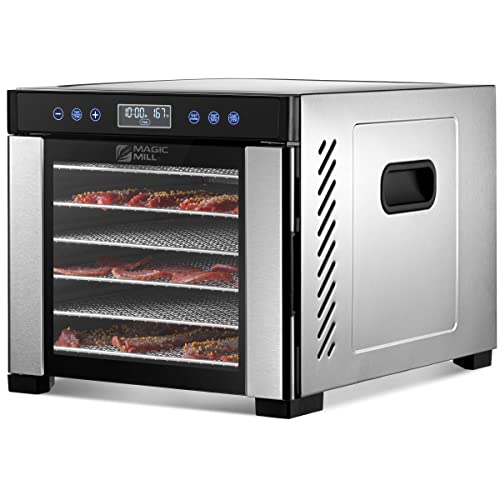
This seven-tray Pro shares the same control layout and rear-fan logic as the ten-tray sibling above, just in a more compact envelope. The XL tray footprint still holds a generous apple slice or banana chip load, so two people drying a few snacks per week rarely run out of room.
It’s a practical middle ground: bigger than a starter, smaller than the full weekend-prep machines.
Where It Delivers
- Seven XL trays balance capacity with counter space.
- Rear fan airflow removes tray rotation from the routine.
- Digital timer supports unattended cycles.
- Stainless trays resist odor transfer between runs.
Honest Caveats
- Not the right size for large single-load garden harvests.
- Top temperature is sufficient for most uses but may not satisfy advanced jerky makers.
Perfect Match For
Couples or small households drying modest weekly batches without giving up a permanent corner of counter space.
Not Your Match When
Garden growers with a sudden overload of tomatoes or herbs will want the higher tray count of the Magic Mill Food Dehydrator Machine 11 Stainless Steel Trays.
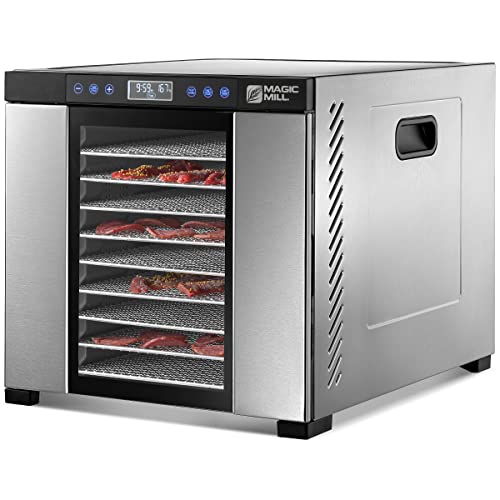
This 11-tray unit was upgraded from its earlier 10-tray configuration, which means roughly 30 more square inches of drying space in the same slim housing. For shoppers who count trays before counting watts, that’s a meaningful bump without a meaningful footprint change.
Adjustable temperature and a digital timer cover the standard range from herbs through fruit and jerky prep, and the overheat protection adds a layer of safety for long unattended runs.
Key Advantages
- Eleven trays offer strong capacity without a bulky housing.
- Slim profile fits more comfortably on narrow counters.
- Overheat protection helps prevent damage during extended cycles.
- Digital controls make repeat runs easy to replicate.
Softer Spots
- Body construction may feel less premium than the all-stainless Pro sibling.
- Top temperature may limit very dry jerky preferences.
Who Should Grab It
Shoppers who want maximum tray count per dollar and don’t need premium stainless walls.
Where Another Pick Suits Better
Cooks willing to spend more for a fully stainless build should consider the Magic Mill Pro Food Dehydrator 7 Full-Size Stainless Steel Trays 600W.
Where most home dehydrators cap out around ten trays, this Premium model pushes to fifteen, paired with an 800-watt heater for faster recovery after loading cool food. Hunters, gardeners, and orchard owners typically zero in on this tier because a single overnight run can finish a season’s worth of jerky or fruit leather.
The rear fan keeps all fifteen trays drying evenly, so the extra capacity doesn’t translate into extra babysitting.
Advantages To Know
- Fifteen extra-large trays handle orchard or garden overload in one cycle.
- 800W heater recovers temperature quickly after a full load.
- Rear fan airflow removes the need to rotate trays manually.
- Transparent door supports passive monitoring during long runs.
Things To Weigh
- Largest counter footprint in this roundup; permanent placement is essential.
- Heavier than smaller models, so moving it for cleaning takes more effort.
Feature Card
Built With In Mind
Gardeners, hunters, and orchard owners with seasonal surpluses who want to dry large quantities in one cycle.
Skip It When
Smaller kitchens and casual snack-dryers will find the Magic Mill Food Dehydrator 5 Stackable Stainless Steel Trays easier to live with daily.
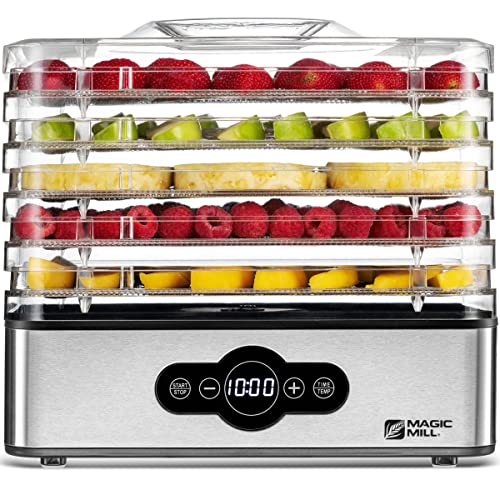
The five-tray compact model is the smallest unit in this roundup, designed for tight counters and casual snack-making. The 240W draw means it plugs into any standard kitchen outlet without tripping breakers, and the stackable trays store flat when not in use.
It’s not built for orchard-scale batches, but for a couple drying herb bundles and a few trays of fruit leather each week, the simpler controls and smaller footprint make daily use less of a chore.
Where It Excels
- Compact footprint fits in apartments and small kitchens.
- Stackable trays store flat when the unit is not in use.
- Lower wattage draws less power over long cycles.
- Stainless trays clean up easily after herb or fruit runs.
A Few Limitations
- Five trays limit batch size, requiring multiple runs for larger projects.
- Lower wattage may extend drying times compared with the larger siblings.
The Right Fit
Beginners and small-space dwellers who only need to dry modest amounts of herbs, fruit, or dog treats at a time.
Another Choice May Suit
Households with growing appetite for dried snacks will appreciate the extra room of the Magic Mill Food Dehydrator Machine 11 Stainless Steel Trays.
Picking The Right Capacity And Heat Range
Before choosing any dehydrator, it’s worth thinking honestly about what you’ll actually dry and how often. A small apartment dweller making herb bundles once a month has very different needs than a backyard gardener processing bushels of tomatoes each August, and the gap between those two scenarios is wider than most spec sheets suggest.
Tray count is the first lever. Five trays handle light weekly snack prep; ten to fifteen trays make sense for batch cooking, hunting seasons, or orchard owners. Each extra-large tray adds roughly 30 square inches of drying surface, so the jump from a five-tray compact to a fifteen-tray heavy-duty model multiplies capacity roughly threefold.
Temperature range matters more than people expect. Low temperatures around 95°F protect the live enzymes in herbs and the bright color of berries, while temperatures above 160°F matter for safe jerky finishes. A model that tops out at 167°F covers most home uses, but anyone serious about jerky may want the 176°F ceiling found on the all-stainless Pro model.
Wattage drives recovery time after loading cool food. Lower-wattage compact units take longer to climb back to temperature, which extends total drying time. Higher-wattage machines cost more to run but finish faster, a trade that matters more during long cycles.
Considering Materials And Maintenance
Stainless steel trays last longer than plastic and resist staining from tomato skins, berries, or beet slices. They also tolerate higher heat without warping over time. Plastic-bodied dehydrators cost less up front, but the trays can absorb odors between runs and may need replacement sooner.
Look for units with removable trays that fit in a sink, plus a door that wipes clean without tools. Transparent doors double as a monitoring window, which means fewer heat-losing openings during a cycle.
Where Timer And Safety Features Help
A 48-hour digital timer turns long overnight cycles into genuinely hands-off work, especially when paired with auto shutoff. Overheat protection matters more for unattended runs in warm kitchens, since extended drying sessions can stress internal components over time.
Balancing Size, Noise, And Storage
Larger machines deliver more capacity but eat more counter real estate. If your kitchen lacks a permanent spot, consider a stackable compact model that disassembles for storage. Fan noise varies, and most home dehydrators run quieter than a microwave, but extended cycles in shared spaces can become a factor over time.
Key Considerations Across These Picks
Common Shopping Slip Ups
A frequent mistake is buying more capacity than you’ll use. A fifteen-tray unit in a studio apartment becomes an obstacle that sits on the counter unused. Match tray count to your realistic weekly output, not your imagined peak season.
Another slip is ignoring temperature ceiling. Plenty of units handle fruit and herbs fine, then struggle with safe jerky finishing. If jerky is on your list, prioritize models that reach 165°F or higher before you commit.
Why Top Tier Costs More
Higher-tier dehydrators tend to use all-stainless construction, wider temperature ranges, and dual-zone chambers. Those upgrades add manufacturing cost, but they also extend machine life and unlock food types the entry-level models can’t reach safely.
For casual snack-makers, that extra cost rarely pays back. For households drying food weekly or running mixed batches, premium features quickly become the difference between a useful tool and an appliance that gathers dust.
Frequently Asked Questions
How long does it take to dehydrate food in a home dehydrator?
Drying times vary by food, thickness, and moisture content, but most fruits take 6 to 12 hours while jerky typically runs 4 to 8 hours at higher temperatures.
Can you dehydrate different foods at the same time?
Yes, in single-zone machines you can stack trays with similar drying profiles, while dual-zone units like the Magic Mill Premium DualZone Food Dehydrator 16 Stainless Steel Trays handle two different temperatures simultaneously.
What temperature is safe for making jerky?
Most food safety guidance points to finishing jerky at 160°F or higher to reduce bacterial risk, so models with at least a 165°F ceiling are worth prioritizing.
Do dehydrators use a lot of electricity?
Compact 240W units draw less power than larger 700W to 800W models, but all run far more efficiently than an oven, especially during multi-hour cycles.
How do you clean dehydrator trays?
Stainless trays rinse under warm water with mild soap, and a soft brush handles mesh screens. Letting trays air-dry fully before storage helps prevent any musty odors from developing.
